

The Primitive Shelter: Why We Feel Safe in Earthy Textures
Exploring the evolutionary psychology behind raw, natural materials — and why a single textured wall can drop your heart rate within seconds of crossing a threshold.
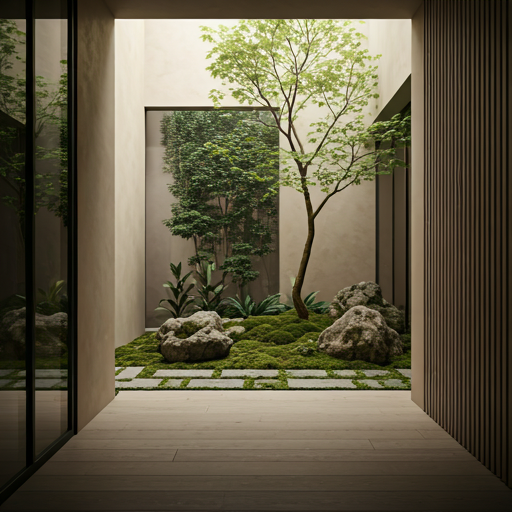
The principle is biophilia, but the mechanism is older than the word suggests. For most of our species' history, the cues that signalled safety were specific and physical: irregular wood grain, hand-shaped stone, the cool weight of clay, the muted greens of slow-growing leaves. The body learned that these surfaces meant shelter — a place that had been arranged by people but not engineered against weather and predators.
What modern materials lose
Polished concrete, plate glass, mass-produced laminate — these surfaces appeared only in the last century. They communicate something the body has never learned to trust: total predictability. The nervous system, reading a perfectly smooth surface, doesn't relax. It stays alert for whatever made the surface that way.
The texture audit
In residential renovations, we increasingly conduct what we call a texture audit — walking each room and counting the number of surfaces that bear visible making. A timber beam with tool marks. A wall with the slight unevenness of hand-applied plaster. A stone hearth whose edges weren't quite straightened. Below three textured surfaces per room, occupants report the space as "cold." Above six, the room reads as cluttered. The sweet spot is four to five, distributed across vertical and horizontal planes.
Designing for the primate
We are still primates. The architecture that does most for our wellbeing is the architecture that quietly remembers that — that gives the body materials it recognizes from long before language.